
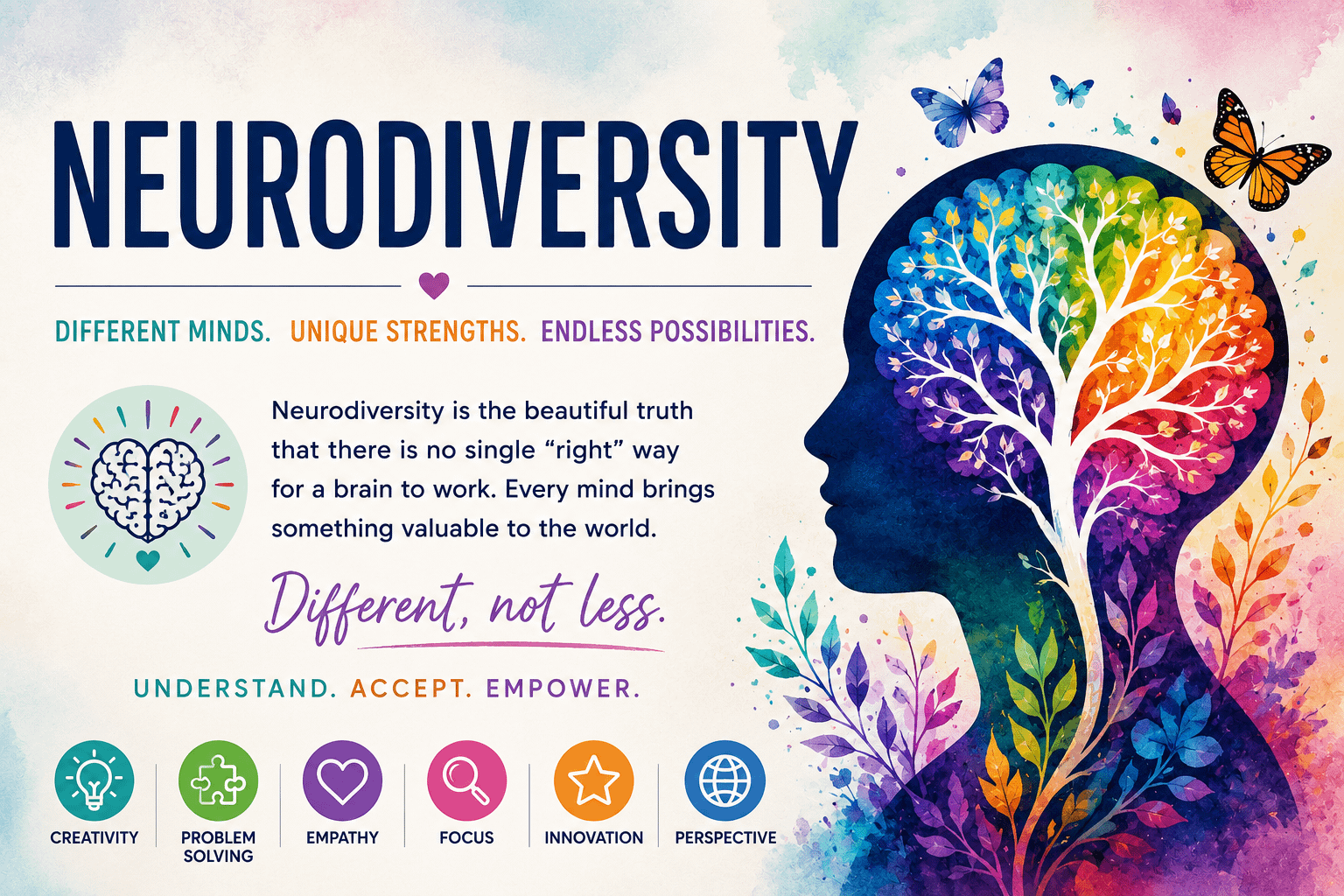
What If You're Not Broken? Understanding Neurodiversity Through a Different Lens
This is the first post in my 'Questions I Ask'.
As someone who is neurodiverse, yet to do an assessment but I know for sure my brain isn't wired for the everyday things I encounter.
I always have to adjust things, so I can be productive.
I've spent many years trying to understand why my mind works the way it does.
Like many people, I've experienced moments of feeling different, overwhelmed, or frustrated by things that seemed easier for others.
So I asked Chatgpt a simple question:
"Teach me neurodiversity like I'm 5 years old."
What followed wasn't just an explanation of neurodiversity. It was a different way of looking at myself, my strengths, my challenges, and the possibility that being different doesn't mean being broken.
For many years, people who thought differently, learned differently, or processed life differently were often made to feel as though something was wrong with them.
They were told to focus harder.
- Be more organised.
- Stop procrastinating.
- Try harder.
- Be more disciplined.
Yet despite their best efforts, many continued to struggle with things that seemed to come naturally to others.
What if the problem isn't that you're broken?
What if you've simply been measuring yourself against the wrong standard?
What Is Neurodiversity?
Neurodiversity is the idea that human brains are naturally different.
Just as people have different personalities, talents, strengths, and interests, people also have different ways their brains process information, emotions, learning, communication, and daily life.
Some people have brains that fit what society considers "typical."
Others have brains that work differently. These individuals are often described as neurodivergent.
This includes people with ADHD, Autism, Dyslexia, Dyspraxia, Dyscalculia, and other neurological differences.
The key thing to understand is this:
Difference does not automatically mean deficiency.
The Wrong Question
For years, society has often approached neurodiversity with one question:
"What's wrong with this person?"
A much better question is:
"How does this person's brain work?"
That simple shift changes everything. Instead of looking for faults, we begin looking for understanding. Instead of trying to force people into a mould, we begin helping them discover how they function best.
The Ferrari In City Traffic
One of the simplest ways to understand a neurodivergent brain is to imagine a Ferrari.
A Ferrari is fast.
Powerful.
Exciting.
Capable of incredible performance.
But put that same Ferrari into slow-moving city traffic and it can feel frustrating to drive.
Many neurodivergent people experience life in a similar way.
They often possess remarkable strengths:
- Creativity
- Innovation
- Big-picture thinking
- Problem-solving abilities
- Energy and enthusiasm
- Vision and imagination
- The ability to connect ideas others cannot see
Yet those same minds may struggle with:
- Organisation
- Time management
- Remembering routine tasks
- Following rigid systems
- Maintaining focus on uninteresting activities
- Finishing projects
The same brain that generates brilliant ideas can sometimes struggle to organise them.
The strengths and challenges are often connected.
The Hidden Cost of Constant Comparison
Many neurodivergent people spend years comparing themselves to others.
- They watch friends seem effortlessly organised.
- They see colleagues manage routines with ease.
- They hear comments such as:
- "Why can't you just do it?"
- "You need more discipline."
- "Everyone else manages."
Over time, these messages become internal beliefs.
People begin to tell themselves:
- "I'm lazy."
- "I'm inconsistent."
- "I'm unreliable."
- "I'm failing."
Yet in many cases, none of these things are true.
The real issue is that they have been trying to live according to instructions that were written for someone else's brain.
The Garden Analogy
Imagine two plants growing side by side.
One is a rose.
The other is bamboo.
The rose blooms quickly and visibly.
The bamboo appears to do almost nothing for years.
Then suddenly, it shoots up at an astonishing rate.
If you judged bamboo using the standards of a rose, you would assume it was failing.
But it wasn't failing. It was simply growing differently.
Many neurodivergent people have spent years judging themselves by someone else's growth pattern.
Perhaps it is time to stop.
Understanding Before Transformation
One of the biggest mistakes people make is immediately trying to fix themselves.
Before change comes understanding.
Before improvement comes awareness.
The first step is not asking:
"How do I become someone else?"
The first step is asking:
"How do I work?"
Other questions will be:
- When do I have the most energy?
- What drains me?
- What helps me focus?
- What environments help me thrive?
- What situations overwhelm me?
The more you understand your design, the better equipped you become to build a life that works with your brain instead of constantly fighting against it.
Systems Are More Powerful Than Willpower
Many people spend years trying to develop more willpower.
Neurodivergent individuals often benefit far more from developing systems.
Instead of relying on memory, use reminders.
Instead of relying on motivation, use routines.
Instead of carrying everything mentally, use checklists, calendars, notes, and accountability structures.
The goal is not to prove how much you can remember.
The goal is to create a life that supports you.
Strong systems often achieve what willpower alone cannot.
Stop Fighting Your Design
One of the most liberating discoveries is recognising that you do not need to become someone else to succeed.
You simply need to understand yourself better.
A fish was never designed to climb a tree.
An eagle was never designed to swim like a dolphin.
Neither is a failure. Both are successful when operating according to their design. The same is true for human beings.
A Faith Perspective
As a Christian, I find this perspective particularly encouraging.
God created extraordinary diversity throughout creation.
- No two fingerprints are identical.
- No two personalities are identical.
- No two life journeys are identical.
The same God who created the eagle also created the tortoise.
- One flies.
- One walks.
Neither is a mistake.
Perhaps some of us have spent years praying to become someone else when God is inviting us to understand who He created us to be.
A Different Way Forward
If you have ever felt different, overwhelmed, inconsistent, or misunderstood, I want to encourage you with this thought:
You may not be failing at life.
You may simply be trying to live life using instructions written for someone else's brain.
Neurodiversity is not about making excuses.
It is about gaining understanding.
And understanding creates freedom.
The more we understand ourselves, the better equipped we become to use our strengths, manage our challenges, and live the lives we were created to live.
Perhaps the goal is not to become normal.
Perhaps the goal is to become fully yourself.
Tokunbo Osunbayo
Is a Financial Educator, Speaker, Trainer, Mentor and Writer. Through her blog, she shares honest reflections and practical insights on money, faith, purpose, personal growth and navigating life differently. Her passion for women reflects in her work and writing. She helps individuals gain clarity, overcome hidden barriers and build more financially stable, purposeful and fulfilling lives. Her Lifestyle Budgeting Sessions are a hit with her clients.