
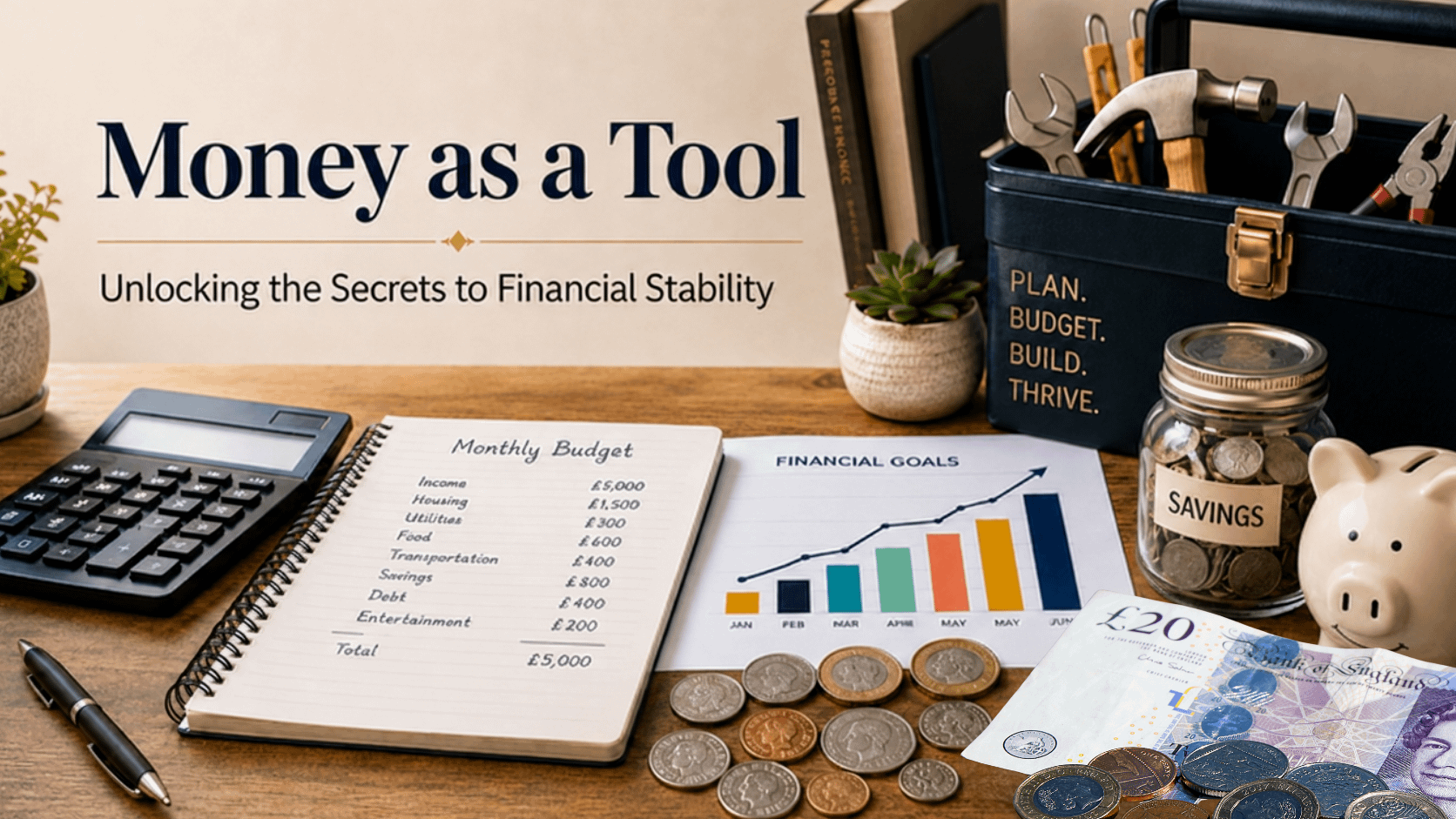
A Tool Is As useful as the purpose it's created for.
Money is often treated as the final goal.
We work for it, worry about it, save it, spend it and sometimes allow it to determine how successful or secure we feel.
But money was never meant to control our lives.
Money is a tool.
Like any other tool, it can help us build something meaningful when we understand how to use it. It can support our needs, fund our goals, create choices and help us prepare for the future.
But a tool is only useful when it has a clear purpose.
Why I Asked This Question
I wanted to explore why some people appear to manage money well while others continue to feel financially unstable, even when money is regularly coming in.
Is financial stability only about earning more?
Or is it also about how we understand, organise and use what we already have?
For many years, I believed that having more money would solve most financial problems. More income would mean fewer worries. More money would create greater freedom. More money would make life feel secure.
But over time, I began to understand that income alone does not automatically create stability.
Without direction, even a good income can disappear.
Without a plan, money can be spent on immediate pressures while important priorities are repeatedly delayed. That's why I run Lifestyle Budget Sessions.
Without clear boundaries, our finances can become controlled by emotions, habits, family expectations and lifestyle choices.
That is when I began to see money differently.
Money is not simply something we earn and spend.
It is something we can direct.
My Question At The Start of the year
As we stepped into 2026 I was in a place where I was tired of just having money to pay bills and also constantly running out of money, I'm a Budget Coach, I should have money working for me.
As a Christian I set aside sometime to map out my year and it was during that session that I asked God what I was not doing right, financially.
This was the response I got, Tokunbo, you don't have any income problem, you have an allocation problem.
In an instant I knew what I needed to do. Once I took the correct action, everything about my finances fell into place, for me that was the missing piece of my financial life.
Over the months it felt like a dream, as month after month I had money left over after bills, who would have thought that a tiny adjustment would bring about a major change in my life.
What Stood Out From My Action
Financial stability does not necessarily mean becoming wealthy or having no financial challenges.
It means creating a stronger financial foundation, and adjusting my financial approach was a complete gamechanger for me.
Financial stability is being able to meet your essential commitments, understand where your money is going and make decisions with greater confidence, getting your money to work for you, than against you.
It is having a plan for unexpected costs rather than allowing every emergency to completely disrupt your life.
It is also knowing that your lifestyle is not constantly demanding more than your income can support.
When money is used as a tool, every amount can be given a purpose.
Money is meant to provide:
- Housing and household costs
- Food and everyday living
- Giving and supporting others
- Savings and emergency funds
- Debt repayments
- Education and personal development
- Rest, enjoyment and meaningful experiences
- Future goals and investments
- And a life in retirement.
The purpose is not to remove all enjoyment or create a life of restriction.
The purpose is to make sure your money is helping you build the life you value rather than disappearing without clear direction.
Money Needs a Job
One of the most practical financial lessons I have learned is that money needs a job, it needs to work for you.
When income arrives without a clear plan, it can easily be absorbed by whatever feels most urgent in that moment.
Bills are paid.
Small purchases add up.
Requests from others appear.
Unexpected costs arise.
A few treats are bought because we feel we deserve them.
Before long, your money's gone and you are left wondering where it all went.
Giving money a job means deciding in advance what each part of your income needs to do.
This may involve dividing your income into different categories, accounts or savings pots.
For example, you may create separate amounts for household bills, food, transport, giving, savings, personal spending and future goals.
This creates financial visibility, because you can see what your money is doing, or should be doing.
It also helps you recognise whether your current income can realistically support your current lifestyle.
Financial Stability Begins With Clarity
Many people avoid looking closely at their finances because they fear what they may discover.
But avoiding the numbers does not remove the problem.
It only delays the decisions.
Clarity allows you to see:
- What money is coming in
- What money is going out
- Which costs are necessary
- Which costs can be adjusted
- Where financial pressure is coming from
- Which habits are affecting your progress
- What needs to change
- And finally, what your mind is saying about money.
You may discover that your income genuinely needs to increase, to have or maintain the lifestyle you desire.
You may find that debt repayments are placing too much pressure on your monthly finances.
You may realise that family responsibilities are affecting your ability to save.
You may also find that small lifestyle expenses have grown into larger monthly commitments.
The purpose of clarity is not shame.
It is understanding.
You cannot change what you are unwilling to see.
More Money Does Not Automatically Create Stability
More income can certainly help, especially when someone is genuinely not earning enough to meet their essential needs.
But more money does not automatically correct poor financial habits.
Without a system, additional income can quickly become additional spending.
As earnings rise, lifestyle expectations often rise with them.
A larger income may lead to a more expensive home, higher monthly commitments, increased lending or greater pressure to support other people.
This is why financial stability is not built by income alone.
It is built through a combination of:
- Sufficient income
- Wise allocation
- Clear priorities
- Healthy financial behaviours and habits
- Appropriate boundaries
- Regular planning
- Personal responsibility
Money can create opportunities, but it still requires direction and purpose.
Your Financial Habits Matter
The way we use money is often connected to more than mathematics.
Our financial decisions may be shaped by our upbringing, beliefs, emotions, past experiences, culture, faith and all the other examples we saw growing up.
Some people save because it gives them a sense of safety.
Others spend because money was always scarce and they want to enjoy it while it is available.
Some avoid opening letters or checking accounts because financial information creates anxiety.
Others feel responsible for helping everyone around them, even when doing so causes personal hardship.
These patterns can quietly control our finances.
Using money as a tool requires us to understand the person holding the tool.
We may need to ask ourselves:
- What do I believe money represents?
- What usually triggers my spending?
- Do I plan before I spend?
- Do I find it difficult to say no?
- Do I regularly spend money to improve my mood?
- Am I trying to maintain a lifestyle I cannot comfortably afford?
- What financial habits keep repeating in my life?
These questions are not intended to create guilt.
They are designed to help us identify what may be holding us back.
Financial Stability Is Built Gradually
There is no single action that creates financial stability overnight. It is usually built through repeated decisions. It may begin with checking your bank balance regularly instead of avoiding it.
It may involve creating a realistic monthly budget.
It could mean starting a small emergency fund, even if the first amount feels insignificant, this is a big one for me, having an emergency fund means you can borrow from yourself instead of others.
It may require reducing one expense, paying off one debt or having a difficult conversation about financial boundaries. Progress does not always look dramatic.
Sometimes financial progress is simply reaching the end of the month with money still available for an important priority.
Sometimes it is paying a bill on time without borrowing or not making an emotional purchase. For some it is finally admitting that your current lifestyle needs to be reviewed.
Small financial decisions can create powerful long-term results.
What I’ll Try Next
I will continue looking at money as something that needs direction rather than something that simply comes and goes. Allocating my money to my lifestyle is what I do on a regular basis and it has created immense peace of mind, it not that I don't have the occasional times where I almost wander into old ways but I quickly adjust and get back on track.
Having a lifestyle budget has significantly helped direct my financial life, this is something I teach others to do in my Lifestyle Budgeting Sessions.
Now I ask, what does this money need to do for me?
Before spending, I will consider whether the decision supports my current needs, my financial wellbeing or the future I am trying to build.
I will also review my financial allocations regularly because life changes.
- Income changes.
- Household costs change.
- Family responsibilities change.
- Priorities change.
A Lifestyle Budget should not be created once and then forgotten.
It should grow and change with your lifestyle, because lifestyles adjust as we age through the decades, the lifestyle you live in your 20's might not apply in your 30's and definitely not in your 40's and onwards.
If You’re Like Me
You may have spent years believing that your financial situation would improve when you finally earned more money.
And perhaps more income is genuinely part of the solution.
But while working towards increasing your income, you can also begin strengthening the way you manage what is already available.
Start by looking honestly at your current financial lifestyle.
What is your money currently building?
Is it building stability, peace and future choices?
Or is it mainly responding to pressure, habits and immediate demands?
Money is indeed a tool to reaching financial stability.
And when you learn how to use it with greater clarity and purpose, it can help you create a more fulfilled and purposeful life.
Join the Conversation
What is one thing you could change about the way you currently use money?
Would you create a budget, start an emergency fund, reduce an expense, review your habits or give your money a clearer purpose?
Maybe you'd like a Lifestyle Budgeting Session, check it here
Financial stability rarely begins with one large breakthrough.
It often begins with one honest decision.
I hope its one you are ready to take?
Tokunbo Osunbayo
Is a Financial Educator, Speaker, Trainer, Mentor and Writer. Through her blog, she shares honest reflections and practical insights on money, faith, purpose, personal growth and navigating life differently. Her passion for women reflects in her work and writing. She helps individuals gain clarity, overcome hidden barriers and build more financially stable, purposeful and fulfilling lives.
Her Lifestyle Budgeting Sessions are a hit with her clients.